
Scroll any feed for five minutes and you'll find it. The event flyer with letters that almost spell words. The burger with a shine no burger has ever had. The smiling family with one hand too many resting on the couch. Nobody set out to make bad work. They typed a sentence, got something glossy back, and hit post.
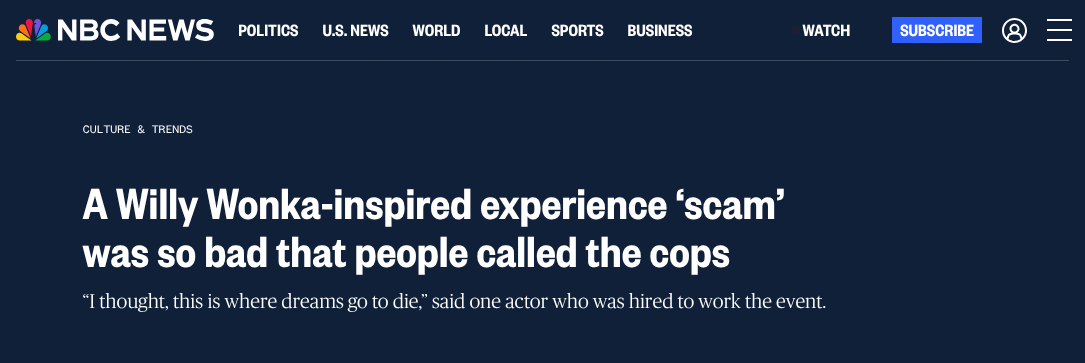
The poster child might be Willy's Chocolate Experience in Glasgow. Families bought £35 tickets off dreamy, candy-colored website images that looked AI-made, then walked into a sparsely decorated warehouse. The event was canceled and the police were called (NBC News).
That's the real shift with generative AI. Production used to be the bottleneck. You needed the software, the skills and the hours. Now anyone with an idea can make something that looks finished in under a minute. That's genuinely exciting. It's also why so much of what's out there looks the same and feels a little off.
Here's my take, after over a decade on both sides of the creative table: the people who get the most out of AI aren't the ones who just discovered they can make a flyer. They're the creatives who already knew what a good one looks like.
Quick gut check
Out of 10 people, how many do you think trust an ad made entirely by AI?
What it looks like: content that's technically fine and somehow wrong. The food is too perfect. The light comes from nowhere. Every image has the same airbrushed sameness.
It's easy to wave this off as designers being precious. The numbers say otherwise. In The Harris Poll's research on UK consumers, seven in ten said they trust ads created entirely by humans. That falls to four in ten when AI tools are used, and to two in ten when an ad is generated by AI alone. Two-thirds said AI-generated ads feel less authentic, and 64% said they suggest less effort.
That last one stings. Effort is a signal. When an ad looks like nobody tried, people assume nobody will try once they're a customer either.
What it looks like: "Relax, nobody will notice."
A Clutch survey found 66% of consumers felt confident they could spot an AI-generated photo. When tested, 57% got it wrong. So sure, you might get away with it on any single post. But 84% in that same survey said disclosure is important, and nearly 40% said they'd trust a brand less if it used AI images without saying so.
And getting caught doesn't take a forensic analyst. It takes one commenter. Ask Coca-Cola. Its 2024 AI remake of the classic "Holidays Are Coming" spot tested well at first, then turned into a pile-on, with critics saying AI had sucked the warmth and joy out of a holiday classic. If a brand with that budget and that heritage can take that hit, the local restaurant posting a six-fingered chef is not safe.
And the lesson didn't stick. A year later, McDonald's Netherlands pulled its own AI-generated Christmas ad after viewers called it unsettling (NBC News).

What it looks like: the dish on the menu that looks nothing like the dish on the plate.
The same Harris research found people are least comfortable with AI in exactly the places brands lean on it most: beauty and skincare (24% comfortable), fashion modelling (28%), travel destinations (29%) and food photography (31%). For backgrounds and conceptual uses, comfort jumps to 53%.
You can see it on actual sidewalks. One X post calling out AI-looking food signs outside New York delis and cafés racked up 2.8 million views (Fortune). In Burlington, Vermont, Myer's Bagels mixed real photos with AI-juiced ones, got called out by its own customers, pulled the images and apologized. As the owner put it, "overall, it didn't work" (PetaPixel).
That's a rule of thumb you can actually use. If the image is a promise about something real (a meal, a product, a place, a person), make it real. If it's mood, texture, or an idea you couldn't photograph anyway, AI is a fantastic tool.
What it looks like: the first output is the starting point, never the deliverable.
Watch a good designer, editor or producer work with AI and you'll notice they rarely keep what it hands them. They generate a texture and bring it into Photoshop. They rough out a form, then build it properly in Blender. They use AI to clean up audio or spark a loop, then finish the track in Ableton. They block out the idea fast in Canva or Illustrator, then sweat the type, the spacing and the crop.
The idea is theirs. The finish is theirs. AI just shortened the boring middle.
We live this at MCPC. AI doesn't set our strategy, write our messaging or come up with our creative. Our team does that. Where AI earns its keep is the follow-through: the execution work that used to slow everything down. That's what's made us super agile and able to jump on opportunities quickly.
That's also where the trust lives. Six in ten people in the Harris study said a person should always be involved in creating advertising that uses AI. The audience isn't anti-AI. It's anti-nobody-home.
I'll be honest about what the data says, because it isn't "never use AI." Even ads made with AI tools lose some trust next to fully human work, so craft isn't a free pass. But the gap between "a person used AI" and "AI made it" is enormous, and that gap is the whole argument.
Consumers can tell when something was made with care, even when they can't tell how. Speed and volume used to be the advantage of having a production team. AI gave that away to everyone. What it can't give away is the idea, the taste to know when something's off, and the craft to fix it.
So hire for that, or be that. Use AI to get to a draft faster, then finish it in the tools that let you make it yours. Disclose it when it matters. And if the image is a promise about something real, keep it real.
Anyone can make something now. The brands that win will be the ones that clearly meant it.
I help B2B and B2C teams build marketing engines that compound — strategy first, systems underneath.
