
For years, plenty of good companies grew without much marketing at all. They hired strong reps, gave them a territory and a phone, and let relationships do the rest. Marketing, if it existed, made the brochure, ran the booth and fixed the logo on the deck.
That worked because the rep was the buyer's best source of information. If you wanted to know what a managed services provider did, what it cost, or who else used it, you had to talk to someone.
That's not true anymore.
Today's buyer does the homework alone. They search. They ask ChatGPT or Gemini for a shortlist. They read Reddit threads, G2 reviews and a competitor's comparison page. They watch a webinar at 11 PM. By the time they fill out a form or take a call, they've already decided who's in the running.
Your reps didn't get worse. They just stopped being the first conversation. And if your company isn't part of the research, there is no conversation.
This is what I mean when I say the sales-led playbook is extinct. Not that sales doesn't matter. It matters as much as ever. But sales can't carry awareness, trust and access by itself anymore. Those jobs moved to channels most sales-led companies never built.
The new playbook isn't "do more marketing." It's knowing which marketing functions move your number and running them on purpose.
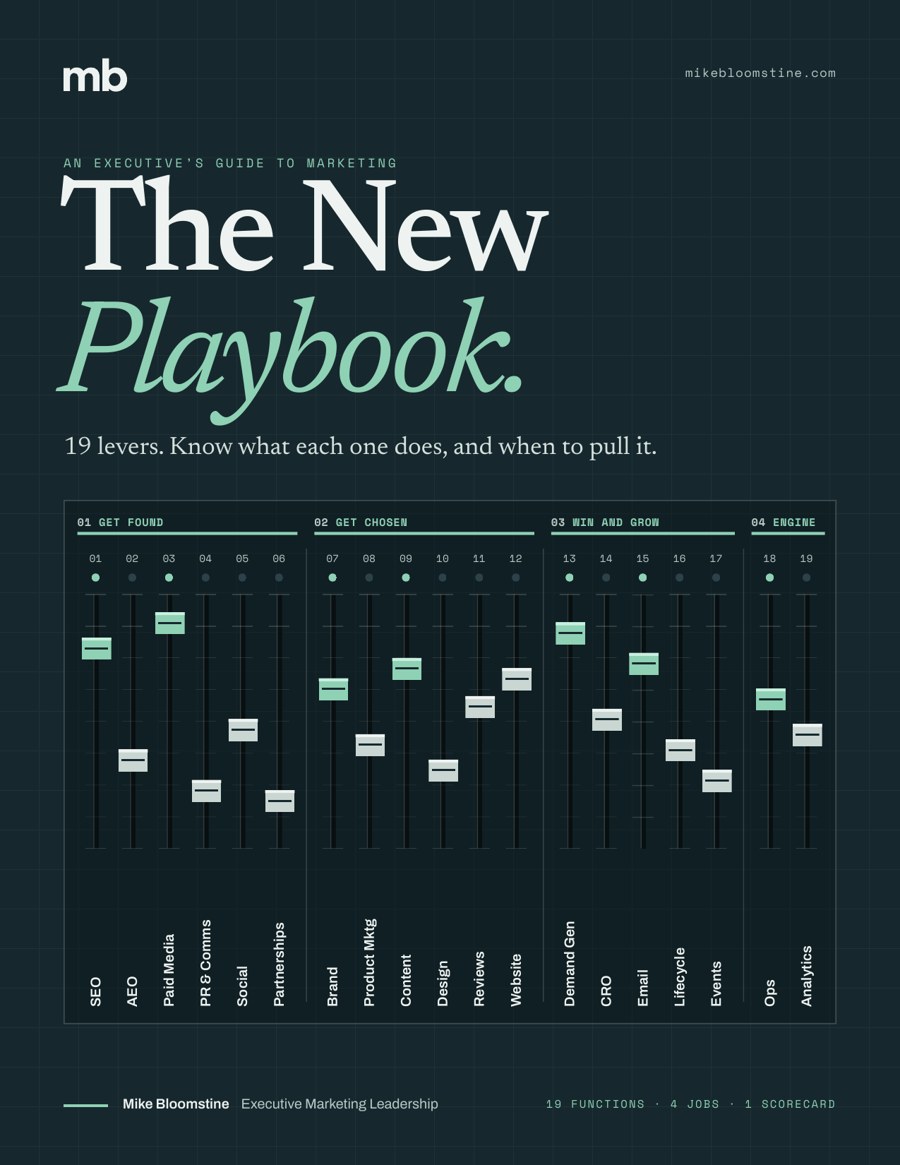
There are 19 of them, and they sort into three jobs plus an engine underneath:
Most companies I talk to that came up through sales are solid on the right side of that list. Events and email work because reps needed them. The gaps are almost always on the left, where buyers make up their minds before anyone calls, and underneath, where nobody can say which dollar paid off.
This is the part that should be a relief. You don't need to be great at everything. A company selling into hospitals and a company selling mattresses need very different mixes. What you need is an honest read on three things for each function: who owns it, how good you are at it, and how much it matters to your business right now.
When you put those side by side, the plan usually writes itself. The functions that matter most and that you're weakest at go first. The ones you're good at but don't need get trimmed. Everything else waits.
If you're the CEO, president or CRO now responsible for a marketing engine you didn't build, start with one question in your next leadership meeting: "Where did our last ten customers first hear about us?"
If the honest answer is "a rep found them," you're running the old playbook. If nobody knows, start with the engine. Either way, you've just found your first priority.
I put the whole thing into a guide. The New Playbook: An Executive's Guide to Marketing covers all 19 functions in plain language: what each one does, how it hits revenue, the KPIs to watch, and when to pull each lever. It includes the scorecard I use to rate every function with a leadership team. It's free. Get the guide →
An executive’s guide to marketing. All 19 functions in plain English: what each one does for the business, the numbers to watch, and when to put money behind it.
I help B2B and B2C teams build marketing engines that compound — strategy first, systems underneath.